

As a judge for the GSMA Global Mobile Awards (Mobile Authentication and Security category), Mobile World Congress is a regular part of my annual events schedule. I think my first congress was back in 2006 and in the proceeding 12 years I’ve seen the show grow out of one venue and expand into non-mobile technology. And it’s still a showcase for the latest in mobile technology; this year Samsung took the opportunity to unveil the latest version of its popular Galaxy smartphone – the S9.
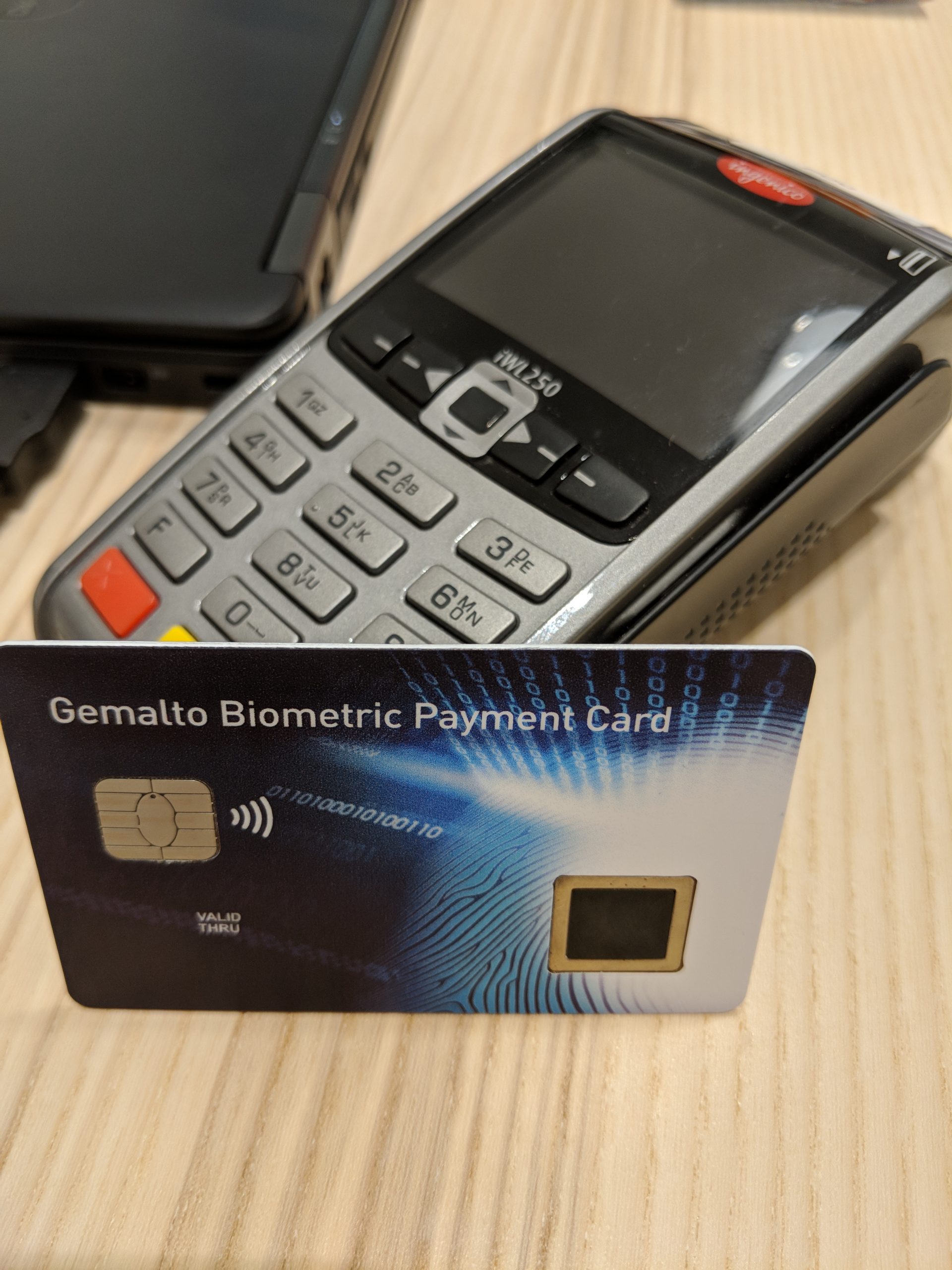
It’s a great opportunity for me to not only meet the movers and shakers in the industry that I have been working with and talking to over the past year but also to get my hands on exciting new technology that is being showcased for the first time – top of my list were the biometric smart cards that were on display and I managed to get a demo from the team at Gemalto.
Biometric Payment Card
In January Gemalto announced details of a pilot it was running with the Bank of Cyprus using an EMV biometric dual interface payment card. The card, using technology from Zwipe and Fingerprint Cards, is being used for both chip and contactless payments and replaces the PIN code with fingerprint recognition. I got my hands on the card used in this demo and was shown how it can be used to authorise high-value in-store contactless payments effortlessly with a fingerprint. To provide feedback to the customer, a series of lights are displayed on the card; red indicating failed verification or enrolment and green indicating a successful verification and enrolment. I believe enrolment will be one of the tricky processes to get right. The enrolment is being tested as part of the pilots and involves a customer either visiting a bank branch or using a Gemalto tablet equipped with a fingerprint reader and software or using an USB reader at home.
Gemalto was not the only company showcasing biometric payment cards. IDEMIA was also exhibiting its version of a biometric payment card, F.CODE.
Biometrics for the Connected Car
IDEMIA showcased a number of biometric solutions at MWC 2018, in addition to the biometric payment card. Notably, a partnership with Omoove supporting biometric access to cars using facial recognition on smartphones. The solution, named EasyOpen, demoed opening a Maserati Levante with a selfie. At Goode Intelligence we forecast that by 2020 nearly 29 million people will be using biometrically-enabled auto mobile apps. [1]
Another company active in the auto market is FlexEnable, a UK-based developing flexible LCD displays and flexible fingerprint sensors. I met up with Dr Rouzet Agaiby, Senior Business Development Engineer at FlexEnable to get a demo of their technology and immediately thought how relevant flexible displays with integrated fingerprint sensors could be for the auto and IoT markets. Being able to wrap a display around a car’s centre console or even around a steering wheel could open up many valuable use cases for auto OEMs.
Next Generation Biometrics for Smart Mobile Devices
Sticking to its MO of being the world’s greatest mobile show, there was plenty of shiny mobile tech on display. Samsung uses MWC as the launch-pad for its latest Galaxy smartphone releases and the sleek S9 didn’t disappoint. It is probably the most biometrically-equipped smartphone ever to ship supporting 2D facial recognition, iris recognition and sporting a rear-mounted touch fingerprint sensor. As our latest research discovers [2] it’s all about giving consumers choice and matching the right biometric modality to the context of its use. 2D facial recognition is OK for unlocking the device but because it can probably be spoofed relatively easily you will probably need to combine an iris scan for it to access an enterprise or commerce app. The touch fingerprint sensor is quick and secure enough for it to authorise a mobile payment. I got to test out the biometric capabilities of the S9 at the show and was impressed at the speed of the face and iris recognition.
I was excited to hear about the Vivo APEX all-screen smartphone that promised a “Half-Screen In-Display Fingerprint Scanning Technology.” Supporting an integrated fingerprint sensor for a bezel-free smartphone design has been a significant challenge for mobile OEMs with the promise of in-display or under-glass fingerprint scanning difficult to achieve. Existing small-area size capacitive sensors have been difficult to integrate with large-area sized OLED touchscreens. OEMs have tested out optical and ultrasound fingerprint sensors and have had problems with reliability and accuracy. Vivo has chosen an optical fingerprint sensor and this requires backlighting to scan the finger. You can choose to either enrol a single or dual finger as the sensor covers approximately a third of the lower-middle part of the screen. As it is a concept device the user experience for the fingerprint scanning is not as quick as you would see with existing touch capacitive sensors but we may see future devices with a better experience. There is a pretty good youtube video showing the fingerprint sensor here https://www.youtube.com/watch?v=P8pHPKIc3qU
Showcasing FIDO
It was great to see FIDO authentication being showcased at MWC 2018 with a number of biometric and authentication vendors exhibiting. I believe we are on the verge of mass FIDO deployments and 2018 will be a pivotal year for the Passwordless replacement. Daon, Samsung SDS, Nok Nok Labs and Sensory Inc. were all in attendance.
[1] Biometrics for the Connected Car – Automotive Biometrics Market Analysis & Forecasts 2018-2023 (Published November 2017) https://www.goodeintelligence.com/report/biometrics-for-the-connected-car-automotive-biometrics-market-analysis-forecasts-2018-2023/ [2] Mobile & Wearable Biometric Authentication Market Analysis and Forecasts 2017-2022 (fourth edition published September 2017) https://www.goodeintelligence.com/report/mobile-wearable-biometric-authentication-market-analysis-forecasts-2017-2022-4th-edition/