

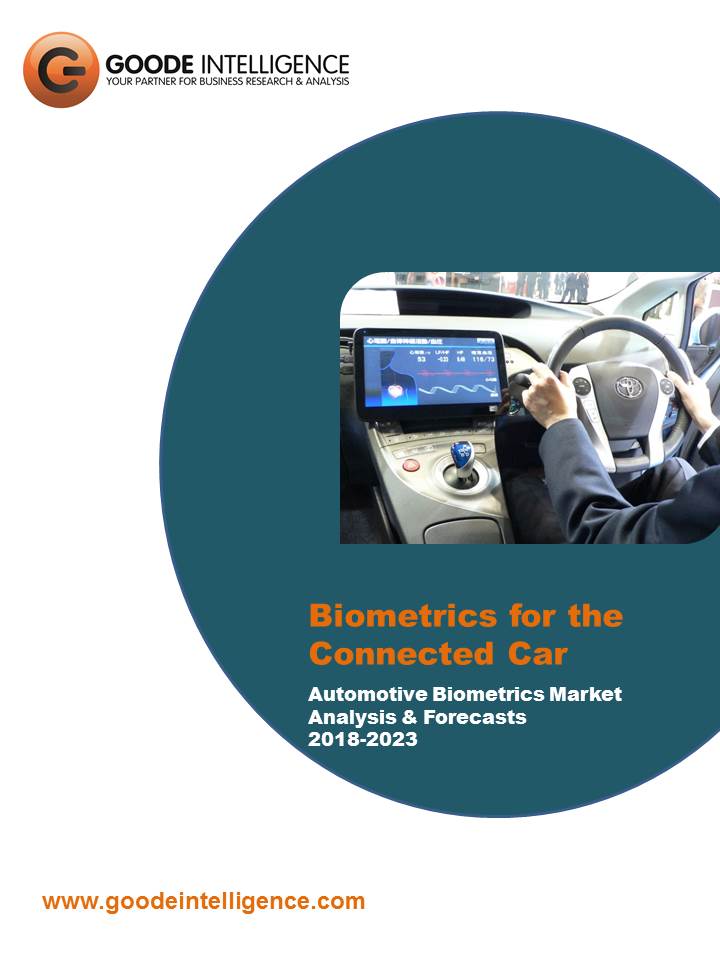
London, United Kingdom –13 November 2017 – Goode Intelligence (www.goodeintelligence.com), a leading cyber security research, analysis and consulting organisation, has today issued a new Analyst Report, examining the biometrics market for the connected car.
In the report, Biometrics for the Connected Car; Automotive Biometrics Market
Analysis & Forecasts 2018-2023, Goode Intelligence indicates that the market for this area has significant value especially from 2021 onwards, forecasting that by 2023 the market will be valued at just under one billion dollars at $969 million, with a CAGR of 96 percent over the six year period from 2018.
While the adoption of biometrics for automotive is presently low, there is significant activity underway with automotive original equipment manufacturers (OEMs). Goode Intelligence predicts it will take the market around three to five years to start deploying biometrics in greater volumes for in-car and supporting biometrics on smart mobile and wearable devices.
Alan Goode, CEO & Chief Analyst, Goode Intelligence said “This emerging area is set to awake the wider market with many leading car OEMs planning to launch top-of-the-range vehicles supporting biometrics from 2018. This in turn represents significant opportunity for those supplying biometric hardware and software to the auto industry – for many different applications, not just security.
“As cars evolve into smartphones on wheels, the automotive industry is facing stiff competition from new entrants such as Tesla and the possibility that technology giants Apple and Google will again disrupt another market. Identity becomes a key battleground for this market and, as with the mobile industry, biometrics is fast becoming the easiest way for people to prove their identity across a wide-range of end-points including the connected car.
“The report shows that there are exciting opportunities for personalisation, in-car payments, insurance, health and well-being, vehicle to home automation and integrating smart cars into smart cities. All of this starts by identifying who is in the vehicle, making biometrics a ‘need to have’.
“The ability for a connected car to accurately identify who you are has become a crucial function in the development of next-generation personal transportation systems. Biometrics not only provides a convenient way to identity a person but also enables automotive OEMs to accurately detect the health and wellbeing of both drivers and passengers alike.”
The report examines in detail the rising level of activity in this growing market including:
- The benefits of using biometrics in the auto market
- The technologies that will dominate
- Disruptive business practices that biometrics could enable
- The effect of regulation on the market
- The sectors that will see the biggest growth
- The vendors set to dominate the market
- Opportunities for investment
More information about the report is available at www.goodeintelligence.com
Notes to editors
The report identifies the following seven key applications and use cases for biometrics for the connected car:
- Vehicle entry using:
- Smartphone
- Wearable
- Key fob
- External cameras
- Engine start using:
- Starter button
- Button-less using biometric sensors embedded in the steering wheel
- Personalisation:
- Linked to engine ignition
- Facial or ocular recognition using camera in dashboard or close to rear-view mirror
- Voice through command centre
- Smart Mobile or Wearable Device interoperability
- In-car payments:
- Car detects the driver during set-up and may re-authenticate using biometric method; Ocular, Face, Voice or ECG
- Supports drive-through restaurants, petrol stations, electricity recharge points and road tolls
- Insurance:
- Car detects the driver and can feed this to ‘black-box’ insurance systems or data created and passed on to insurance companies in the event of an accident
- Could also be used by law enforcement in the event of a traffic accident or other incident/felony
- Health, wellness and well-being (HWW):
- Support for Advanced Driver Assistance Systems [ADAS]
- Continuous monitoring for tiredness, illness and intoxication through face, ocular, ECG and EEG biometrics
- Car to Home Automation:
- Control of home automation systems and link to the wider IoT world
About Goode Intelligence
Goode Intelligence is a leading cyber security research, analysis and consulting organisation founded in 2007 and is based in London. For more information about Goode Intelligence please visit www.goodeintelligence.com
For further information contact:
Michelle Welch, Sales & Marketing Director, Goode Intelligence
Tel: +44(0) 203 633 1269 Email: michelle.welch@goodeintelligence.com
Issued by:
Goode Intelligence
Email: enquiry@goodeintelligence.com; Web: www.goodeintelligence.com